

When jewelers first consider an XRF analyzer, the question is usually straightforward: “Can it test gold purity?” But here’s what separates a basic purchase from a strategic investment—asking what else it can do.
A jewelry manufacturer in Mumbai recently asked us about the Aurum5i Pro Multicollimator: “I see four application modes – Metal, Liquid, Gemstone, and Coating. If I want to test gold-plated items, which one do I use?”
It’s a smart question that reveals something important: the best XRF machines aren’t single-purpose tools. They’re multi-dimensional systems that grow with your business.
Understanding the Four Applications
Metal: Your Primary Defense System
This is your daily workhorse. Test gold, silver, platinum, and 30+ elements in seconds. But here’s what makes it powerful—it detects unwanted elements too.
Iridium, ruthenium, rhenium, lead, osmium – these are the alloying elements that can compromise your metal quality or signal sophisticated fraud. Finding them early prevents expensive mistakes.
Gold Plating Alert lives here as a built-in protection feature. You don’t switch modes – the system automatically flags when you’re testing plated material on base metal. It’s not measuring coating thickness; it’s protecting you from buying plated items at solid gold prices.
The Multicollimator Advantage: Seeing What Others Miss
Here’s where the Aurum5i Pro MC changes the game entirely.
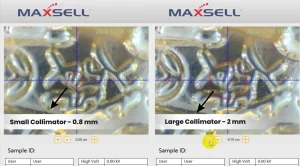
Traditional XRF analyzers have a fixed beam size. They test the surface area they can reach – and that’s it. But sophisticated fraud doesn’t happen on obvious surfaces. It happens in the hidden joints, the soldered connections, the clasps, the inside of hollow bangles where a different alloy is used.
The multicollimator system uses smaller, adjustable collimators to access these vulnerable spots. Think of it as the difference between a floodlight and a focused laser – you can direct your analysis exactly where purity theft typically occurs.
The motorized camera focus brings those tiny, concealed areas into sharp view. What other XRFs simply can’t detect, the Aurum5i Pro MC shows you clearly. You’re not just testing jewelry anymore—you’re investigating it.
A jeweler tests the visible part of an ornate necklace: 22K gold, perfect. But what about that intricate clasp? The soldered joint hidden beneath the design? With multicollimator precision, you can test those spots directly. Power is in your hands – literally. You decide what gets tested, not the limitations of your equipment.
Coating: The Manufacturer’s Edge
For production houses, this changes everything.
Rhodium plating costs money. Gold plating costs more. How thick are you actually applying? Are you over-plating (wasting expensive metal) or under-plating (risking customer complaints)?
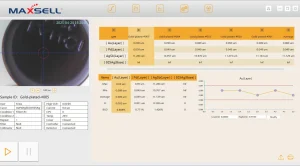
The Coating application measures plating thickness in microns, turning guesswork into data. Manufacturers use this to standardize their processes, reduce material waste, and maintain consistent quality across thousands of pieces.
When to use what: Testing if an item is gold-plated? Use Metal mode – the plating alert catches it. Measuring how thick your rhodium coating is? That’s Coating mode.
Liquid: Where Chemistry Meets Profit
Electroforming technology is reshaping jewelry manufacturing. Entire pieces can be grown in chemical baths containing dissolved gold, silver, copper, and zinc.
Here’s the challenge: You might have 1-3 kg of gold dissolved in that bath. As production continues, the metal concentration changes. When do you replenish? How much is left?
The Liquid application tests the bath solution directly, measuring metal content in mg/liter. It’s not laboratory-grade precision, but it gives manufacturers the directional data they need to manage thousands of dollars in dissolved precious metals.
Most retail jewelers won’t need this. But if you’re scaling up to manufacturing, it becomes invaluable.
Gemstone: The Future-Facing Feature
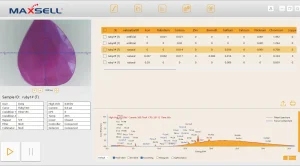
Gemstone authentication requires multiple tests – XRF is one piece of the puzzle. This application helps differentiate synthetic from natural stones by analyzing elemental composition.
It’s admittedly nascent technology. For gemological experts, the elemental data can provide additional clues about grade and treatment. For others, it offers quick screening for obvious synthetics.
Why include it? Because the jewelry business evolves. Lab-grown gemstones are exploding. Having XRF gemstone analysis built-in means you’re not obsolete when the market shifts.
The Real Investment Question
A basic XRF machine tests gold purity. You pay ₹3-8 lakhs, and that’s what you get.
A system like the Aurum5i Pro Multicollimator costs more – but it’s solving problems you’ll face in three years, not just today:
- Retailers: Metal testing + multicollimator precision + plating detection protects your buying decisions at every hidden point
- Small manufacturers: Add coating measurement to control production costs
- Growing businesses: Liquid testing becomes relevant when you scale into electroforming
- Future adaptation: Gemstone screening is ready when you need it
The multicollimator isn’t just a feature – it’s a revolution in how thoroughly you can inspect jewelry. Because fraud evolves, and your equipment should evolve faster.
The question isn’t “Do I need all four applications today?”
The question is “Which machine will still be relevant to my business five years from now?”
Seeing It in Action
We’re currently experiencing high demand for the Aurum5i Pro MC – our demo unit is literally at IIJS as we write this. If you’re attending, stop by and see all four applications demonstrated live, including the multicollimator precision that reveals what standard XRF analyzers simply cannot detect.
Can’t make it? We’re documenting real-world applications with images and use cases. The technology is sophisticated, but the interfaces are built for jewelers, not physicists.
In a market where margins are tight and fraud is sophisticated, your testing equipment should be a strategic asset, not just a verification tool. The best XRF investment isn’t the one that does what you need today—it’s the one that anticipates what you’ll need tomorrow, and sees what others miss today.
Want to discuss which configuration makes sense for your specific business model? Let’s talk about where you’re headed, not just where you are